InsightsMicrolearning vs traditional eLearning for distributed teams
1 May 2025 · Blitz Learning team
Microlearning vs traditional eLearning for distributed teams
Distributed workforces don't have ninety minutes to sit through a course. Here's how short, focused learning fits the way they work, and where it doesn't.
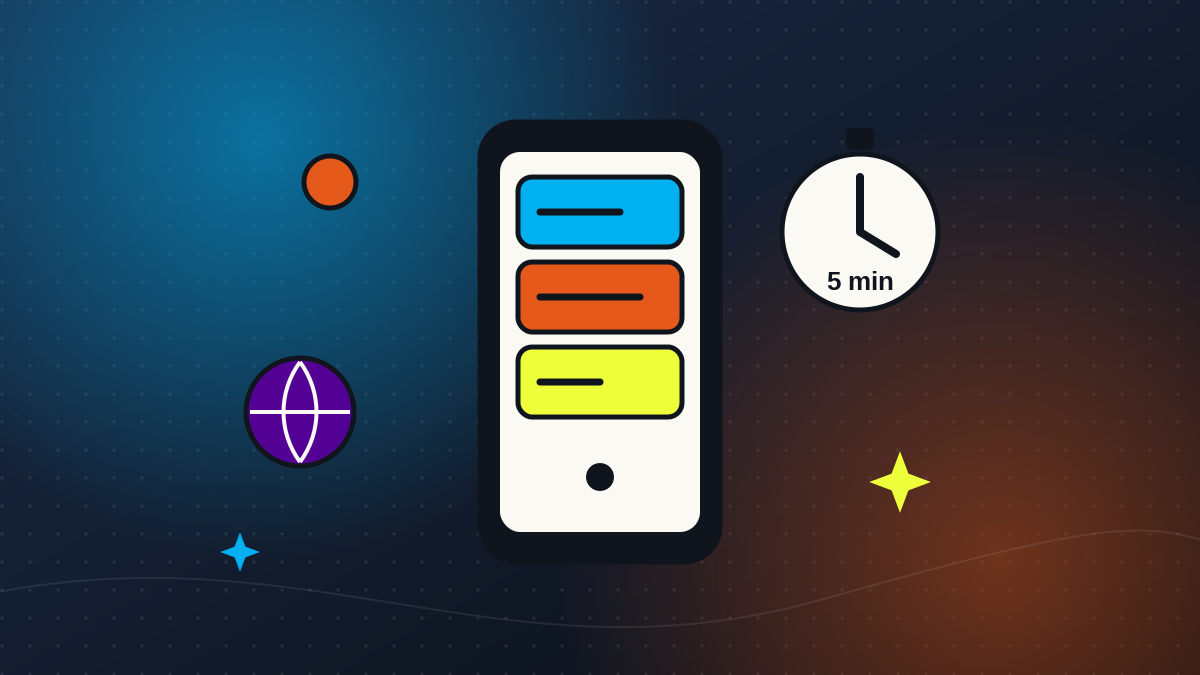
Your sales team is on the road. Your engineers are on shift. Your managers are in back-to-back calls across three time zones. Then a ninety-minute compliance course lands in their inbox, and everyone knows how that goes: it gets left until the deadline, clicked through at speed and forgotten by Friday.
Distributed teams don't lack the will to learn. They lack long, uninterrupted blocks of time. Microlearning works for them because it is built around how they actually work.
What microlearning is, and what it isn't
Microlearning is learning delivered in short, focused pieces, each built around one outcome. A learner should be able to finish a piece in a few minutes and do something new or better afterwards.
It is not a long course chopped into five-minute chunks. If module 4 only makes sense after modules 1 to 3, you have a long course with more clicks. Real microlearning pieces stand on their own. A learner can find the one they need, use it and get back to work.
Why it fits distributed teams
It fits into the gaps. Field and frontline staff learn between jobs, on a phone, often in a noisy place. A short, mobile-first piece with captions and a clear task respects that.
It arrives when the need does. A two-minute walkthrough of a new pricing rule is most useful the week the rule changes, not in next quarter's training plan. Short formats are quicker to build and update, so content can keep up with the business.
It supports remembering, not just finishing. People forget most of what they learn in one sitting unless they come back to it. Short pieces make it easy to space practice over days and weeks, which is one of the best-supported findings in learning science. We cover that in more detail in The science of spacing.
It is easier to localise. Short, modular content can be translated and voiced piece by piece. That matters when your team speaks several languages.
Five design principles we use
- Start from the task, not the topic. "Handle a pricing objection in a renewal call" is a microlearning outcome. "Pricing" is not.
- One idea per piece. If you need the word "also", you probably need a second piece.
- Make the learner do something. A decision, a short scenario, a quick recall question. Watching alone rarely changes behavior.
- Design for the smallest screen first. If it works on a phone in a warehouse, it will work on a laptop.
- Plan the follow-up. Decide up front when the learner will see the idea again, as a question, a reminder or a harder scenario.
Where microlearning is the wrong tool
Microlearning is not a cure-all. Complex skills that need sustained practice, such as clinical procedures, leadership development or safety-critical operation, usually need longer, structured programs, coaching or simulation. Short pieces are good for reinforcing those programs, not replacing them.
It also won't fix a problem that isn't about knowledge. If people know what to do but the process, tools or incentives get in the way, more content won't help.
Getting started
Pick one high-impact task where people struggle today. Build three to five short pieces around it, with a spaced follow-up. Then measure whether the task gets done better, not just whether the pieces were opened. Our article on measuring learning that matters explains how.
If you'd like help choosing where to start, talk to us.