

InsightsThe science of spacing: retrieval practice and retention
1 December 2024 · Blitz Learning team
The science of spacing: retrieval practice and retention
Spaced repetition isn't new, but most eLearning ignores it. What the research says and how to build it into digital learning.
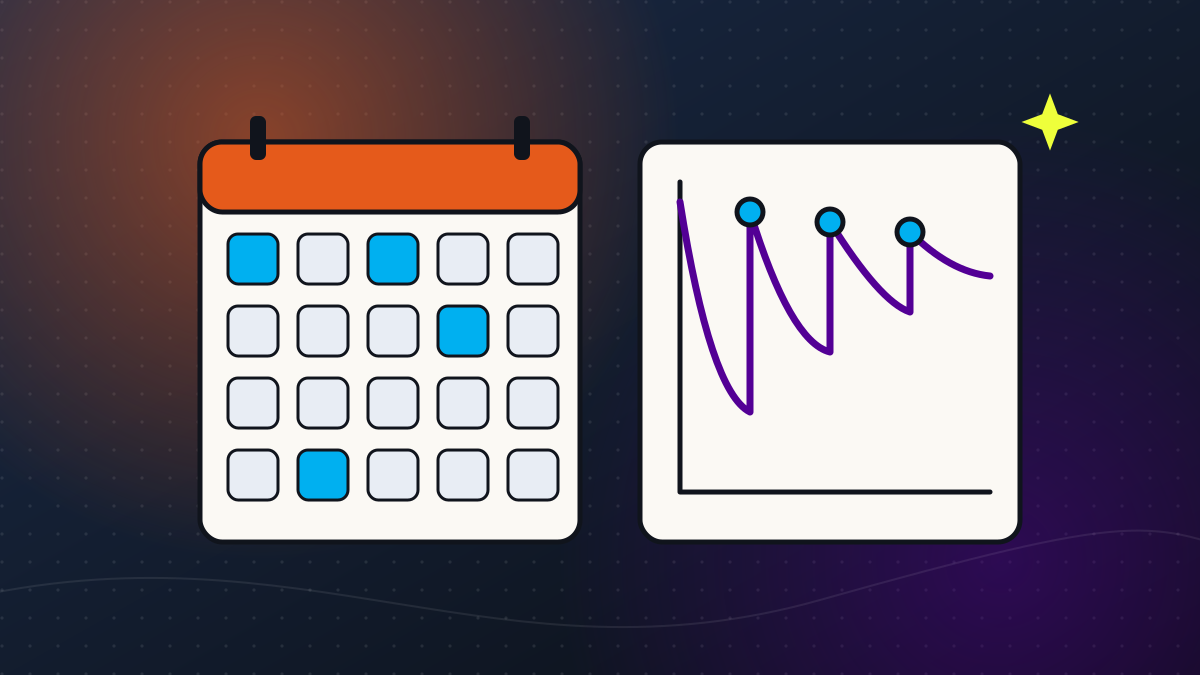
Spaced repetition isn't new, but most eLearning ignores it entirely. Courses are designed to be completed once, in one sitting, and then never seen again. Learning science has known for more than a century that this is one of the least effective ways to make something stick.
The forgetting curve
In the 1880s, the German psychologist Hermann Ebbinghaus tested his own memory of nonsense syllables and found that forgetting is fastest soon after learning, then slows. He also found that reviewing material again later made it easier to relearn and slower to forget. Later research has confirmed and extended the pattern with many kinds of material and learners.
The practical lesson is simple: one exposure is not enough, and when you revisit matters.
Two techniques with strong evidence
Spacing (distributed practice). Spreading study over several sessions with gaps in between leads to better long-term retention than cramming the same amount of study into one session. A large review by Cepeda and colleagues of hundreds of studies found a consistent benefit for spaced over massed practice (Psychological Bulletin, 2006).
Retrieval practice (testing yourself). Trying to recall something strengthens memory more than reading it again. In a well-known experiment, Roediger and Karpicke found that students who practiced recalling a passage remembered more of it a week later than students who spent the same time re-reading it, even though re-readers felt more confident (Psychological Science, 2006).
A review of ten common study techniques by Dunlosky and colleagues rated these two, practice testing and distributed practice, as the most useful of all (Psychological Science in the Public Interest, 2013).
Combined, they are powerful: recall something, then recall it again later, with gaps in between.
Why most corporate learning misses this
- Courses are measured by completion, so the job looks done at the end of the first session.
- Assessments come straight after the content, when everything is still fresh, so scores look good and nothing is reinforced.
- Re-reading and re-watching feel productive, so learners and designers both lean on them.
How to build spacing into digital learning
- Plan the follow-up as part of the design. Decide what learners should still know in a month, and schedule short recall activities to get them there.
- Use questions, not summaries. A follow-up should ask learners to recall or apply, not just remind them.
- Make it short and frequent. A few questions every week or two works better than a long refresher once a year.
- Increase the gap and the challenge. As recall gets easier, space the questions further apart and make the scenarios harder.
- Use the data. Bring back the questions people get wrong more often, and the ones they get right less often.
- Explain why. Learners sometimes find retrieval harder than re-reading. Telling them that the effort is what makes it stick helps them stay with it.
Spacing and retrieval practice are at the heart of how we design for knowledge retention. If you'd like to add them to existing programs, we can help.